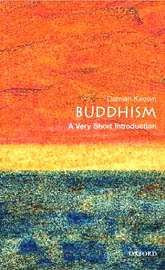
by Damien Keown
Oxford University Press, 2000, 152 pp.
"This accessible volume covers both the teachings of the Buddha and the integration of Buddhism into daily life. What are the distinctive features of Buddhism? What or who is the Buddha, and what are his teachings? How has Buddhist thought developed over the centuries, and how can contemporary dilemmas be faced from a Buddhist perspective? Words such as 'karma' and 'nirvana' have entered our vocabulary, but what do they really mean? Keown has taught Buddhism at an introductory level for many years, and in this book he provides a lively, challenging response to these frequently asked questions."
"Damien Keown, of the University of London and the Royal Asiatic Society, addresses Buddhism past and present, East and West. Keown examines some major questions. For example, is Buddhism really a religion? He looks at seven dimensions of religion and concludes that Buddhism does fit a broader definition of religion. Keown proceeds to look at the origins of Buddhism, the life of the Buddha, ideas of karma and reincarnation, and the central ideas of the Four Noble Truths in Buddhism, etc. There are useful maps, a nice snapshot timeline, and suggestions for further reading, The book is also well indexed and has a useful glossary." Buy from Amazon.com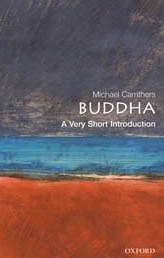
by Michael Carrithers
Oxford University Press, 2001, 120 pp.
"In this valuable introduction, Michael Carrithers guides us through the complex and sometimes conflicting information that Buddhist texts give us about the life and teaching of the Buddha. He discusses the social and political background of India in the Buddha's time and traces the development of his thought. He also assesses the rapid and widespread assimilation of Buddhism and its contemporary relevance. Well-paced and informative, this introduction will enlighten not only those who study Buddhism and comparative religion but anyone intrigued by the remarkable philosophy of one of the greatest religious thinkers."
by Andrew Skilton
Barnes & Noble Books, 2003, 263 pp.
"Buddhism is a widely diverse religion, with many traditions handed down through the centuries. The newcomer seeking to understand the sometimes contradictory spiritual texts can find it daunting. Andrew Skilton, a Buddhist and professor at Oxford University, now unravels these varied religious threads and creates a wonderfully clear and compact look at Buddhist history. From the ancient Indian context to Buddhism in countries beyond, from the Mahayana sutras to Tantra, this book presents an account of the religion's development up through the 19th century, its doctrines and its schools. But the study also covers the context in which Buddhism developed, the external events that had an impact on the religion. Using the most recent scholarship available, A Concise History of Buddhism reflects on the Buddha and his teachings, the paths to awakening, the development in the Sangha, the Tripitaka and the Abhidharma, the end of Buddhism in India, and the practice of Buddhism throughout Asia. A truly enlightening guide".
"A mere couple hundred pages in length, Skilton surveys events in brief eight to twelve page chapters that are easy to read without being simplistic. One gains insight into the great sweep of Buddhism across Asia from Japan in the East right over to Persia in the West. There is also a topically organized, extensive bibliography of primary and secondary sources to further any interest the main text has raised."
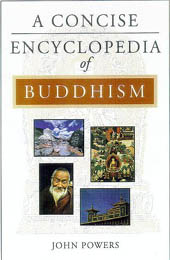
by John Powers
Oneworld Publications Ltd., 2000, 288 pp.
"A comprehensive handbook that covers an impressive range of terms . . . clear and accessible." -- Rupert Gethin
"From the afterlife to Zen, via Tibet and Theravada, this encyclopedia captures the rich diversity of Buddhism in one accessible and definitive volume. Covering the teachings of the early masters to the growth of the tradition in the West, the succinct A-Z entries supply information on Buddhism’s key doctrines, practices and figures. Throughout, Powers balances conciseness with scholarship, explaining complex ideas in a manner that is both informative and accessible. Features include over 900 entries; an 'at-a-glance' chronology; and a substantial and up-to-date thematic bibliography."
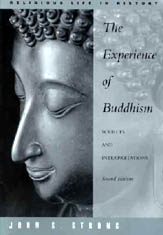
Wadsworth Publishing, 2001, 2nd Edition, 384 pp.
"This comprehensive anthology provides translations of texts illustrative of Buddhist philosophy and doctrine as well as descriptive, concrete accounts of Buddhist practices, rituals, experiences and life situations. This approach does not neglect one dimension of the religion in favor of another. The book also covers the development of Buddhism in a wide variety of geographical and cultural areas (India, Southeast Asia, Tibet, China, and Japan), and gives a sense of the historical evolution of the tradition in these areas.""The presentation of primary texts combined with commentary is an excellent presentation of Buddhist thought. Several historical and philosophical strands can be followed easily with this book. The organization and topical layouts allow the reader to move easily through the texts and focus in on areas of interest. Strong maintains acceptable historical objectivity within the context of a sympathetic presentation, allowing the reader to draw independent conclusions. Any student of Buddhism will benefit from this book."
See Table of Contents.

by Richard H. Robinson, Willard L. Johnson and Thanissaro Bhikkhu
Wadsworth Publishing, 2005, 5th Edition, 368 pp.
"This historical introduction to Buddhism presents students with an engaging exploration of the diversity of thoughts and practices of a wide segment of followers of the Buddha. It covers five main aspects of Buddhism: ritual, devotionalism, doctrine, meditation, practice, and institutional history."
"An overview of the Buddhist Scriptures provides students with a framework for reading the primary sources. A map of regions where Buddhism is largely practiced assists readers in gaining an important geographical perspective. A pronunciation guide and glossary help students gain familiarity with the Buddhist vernacular."
"The book is extensively cross-referenced to The Experience of Buddhism: Sources and Interpretations by
John Strong (also published by Wadsworth). The books can be used independently or as a
set."
Buy from
Amazon.com

An Introduction to Buddhism: Teachings, History and
Practices
by Peter Harvey
Cambridge University Press, 1990, 396 pages
"Peter Harvey's Introduction to Buddhism is to be recommended; in its breadth and scope it is without serious rival as an introductory volume...Harvey is to be congratulated on a rounded and sensitive presentation of Buddhist thought and practice." Times Literary Supplement
"This book is a comprehensive introduction to Buddhist tradition as it has developed in three major cultural areas in Asia, and to Buddhism as it is now developing in the West. It is intended to be a textbook for students of religious and Asian studies, but it will also be of interest to readers who want a general survey of Buddhism and its beliefs. Unlike many other general books about Buddhism, it not only explores the world views of the religion but also attempts to show how Buddhism functions as a set of practices. It thus includes chapters on devotion, ethics, monastic practices and meditation. Such practices are related to Buddhist teachings and historical developments. Emphasizing as it does the diversity found within different Buddhist traditions, the book aims throughout to underline common threads of belief, practice and historical continuities which unify the Buddhist world. Dr. Harvey answers questions that are often asked by people on first meeting the tradition, and in his section on Nirvana offers a novel interpretation of this ultimate, transcendent mystery."
"An Introduction to Buddhism is one of the best overall introductions to this vast subject now available, superseding equivalent good books which are by now up to 50 years too old. Harvey combines scholarship including a knowledge of Pali and Sanskrit along with sensitivity to the contexts in which the various scriptures can be seen."

by Rupert Gethin
Oxford University Press, 1998, 352 pp.
"This is the best introduction to Indian Buddhism that I have seen. It makes extensive use of the most current scholarship." -- David Carpenter, St. Joseph's University
"Buddhism is a vast and complex religious and philosophical tradition with a history that stretches over 2,500 years, and which is now followed by around 115 million people. In this introduction to the foundations of Buddhism, Rupert Gethin concentrates on the ideas and practices which constitute the common heritage of the different traditions of Buddhism (Thervada, Tibetan, and Eastern) that exist in the world today. From the narrative of the story of the Buddha, through discussions of aspects such as textual traditions, the framework of the Four Noble Truths, the interaction between the monastic and lay ways of life, the cosmology of karma and rebirth, and the path of the bodhisattva, this book provides a stimulating introduction to Buddhism as a religion and way of life."
"The Foundations of Buddhism presents an introduction to Buddhism as it really is, as seen through the eyes of millions of its Asian followers."

by Charles S. Prebish
Scarecrow Press, 2001, 2nd edition, 312 pp.
"The book is divided into three parts: a lengthy introduction, the dictionary itself (the bulk of the book), and an extensive bibliography.
"The author's introduction opens with a biography of Siddhartha Gautama, the Buddha, then expounds upon the information in the chronology and the scripture lists. The introductory material also includes a pronunciation guide, a list of Buddhist scriptures from its various branches, a 5-page chronology of Buddhist history, and a map."
"The dictionary itself has approximately 700 entries, each at least a paragraph in length; some take a whole page. Entries include westerners significant in Buddhism, such as Edward Conze and Caroline Rhys-Davids, as well as such Eastern Buddhists as the Dalai Lama and Nichiren; definitions of Buddhist terms and ideas: and important historical events such as the various councils and eras."
"The bibliography contains almost 1,000 entries. These are arranged by subject: Historical Development; Texts in Translation; Religious Thought; Practices; Soteriology; Biography and Mythology; Sacred Places; The Social Order; and The Arts."

by Donald S. Lopez
Penguin Books, 2004, 556 pp.
"While Buddhism has no central text comparable to the Bible or Koran, there is a powerful body of scripture from across Asia that encompasses the dharma, or the teachings of the Buddha. In this rich new anthology of Buddhist texts, eminent scholar Donald S. Lopez, Jr. brings together works from a broad historical and geographical range, and from such languages as Pali, Sanskrit, Tibetan, Chinese, and Japanese. There are tales of the Buddha’s past lives, a discussion of qualities and qualifications for a monk, and an exploration of the many meanings of enlightenment. Together they provide a vivid picture of the Buddha and of the vast and profound nature of the Buddhist tradition."
"Buddhist Scriptures is a selection of Buddhist writings representing the full range of historical periods, geographical origins and literary styles. The text is organized into chapters on: the Buddhist universe; the Buddha; monastic life; meditation and other rituals; and enlightenment. This new edition contains many texts presented in English for the first time as well as new translations of some well-known works, and also includes an informative introduction and prefaces to each chapter by Lopez, with suggestions for further reading and a glossary."

by Donald S. Lopez Jr.
HarperSanFrancisco, 2002, 288 pp.
"Much of what we hear about Buddhism today in the West
focuses on its philosophy, and how it can change one's life. Throughout history, however,
Buddhism's mythology, scriptures, heroes, and its promise for salvation from rebirth have
been the Buddhist teachings that most people have known. Rather than providing a
chronological history or country-by-country breakdown, Lopez in The Story of Buddhism
explores general topics, meandering through two-and-a-half millennia, from India to Japan.
In sections such as 'Monastic Life,' 'Tantra,' and 'Pilgrimage,' he talks about the
origins of each topic and its mainstream manifestations."
"Donald Lopez attempts to present a balanced, accurate
picture of Buddhism as it has been practiced over the generations. His book The Story
of Buddhism considers the actual practice of Buddhism, in all its diverse forms, in
Asia, superstitions, magic, idiosyncracies, etc."
"The focus of the book is on the various schools of Mahayana Buddhism and on the Buddhism of Tibet. There is a great deal of emphasis in the book on how the Buddha's teaching was applied and modified over the years. Most of lay practice, Lopez informs us, was devoted to the accumulation of merit by the practice of good deeds. A regular meditation practice, much less textual study of the Sutras, was simply unavailable to most people who have over the generations called themselves Buddhists, either laity or monastic."
"Lopez describes well the ritualistic practices of any number of Buddhist schools, emphasisizing matters such as relic worship, ancestor worship, fortune-telling and horoscopes, miracle cures, magic, mandalas, and what the modern reader is likely to view as superstition. He briefly describes for the reader a number of Buddhist schools and practices, including Tantric Buddhism, the Pure Land School, and Zen, and their different paths to enlightenment."

by Paul Williams with Anthony Tribe
Routledge, 2000, 336 pp.
"I know of no more lucid expositor of Indian or Buddhist philosophy." -- Richard Gombrich
"Buddhist Thought guides the reader toward an understanding and appreciation of the central concepts of classical Indian Buddhist thought, tracing their development from the time of Buddha to the latest scholarly perspectives and controversies. Of particular interest here is the accessible and up-to-date survey of Buddhist Tantra in India. A detailed bibliography completes a comprehensive, authoritative and engaging introduction to one of the world's great philosophies."
"If you intend to gain a first, yet thorough and actually reliable understanding of the extensive realm of Buddhism, choose this book as your indispensable guide"

by Paul Williams
Routledge, 1989, 317 pp.
"This will without doubt become a standard textbook on the Mahayana. Argument and assertions are throughout backed up by reference to primary sources and there are citations or quotations from texts on almost every page." Journal of the Royal Asiatic Society
"This volume provides an up-to-date and accurate account of the principles of Mahayana Buddhism as they are found in both the Indo-Tibetan and East Asian forms of Mahayana. Throughout, the book places Buddhist doctrine within a historical and cultural context, and provides a basis for students and readers to engage in their own further research and study into Buddhist theory and practice."
"Originating in India, Mahayana Buddhism spread to Central Asia, Tibet, Mongolia, China, Japan and other countries of East Asia. In Tibet and East Asia, Mahayana eventually became the prevalent form of Buddhism. Western interest in Mahayana has increased considerably over the last twenty-five years, reflected both in the quantity of scholarly material produced and also in the attraction of Westerners towards Tibetan Buddhism. This book aims to provide in one volume an up-to-date and accurate account of the principles of Mahayana Buddhism as they are found in both the Indo-Tibetan and East Asian forms of Mahayana. It seeks to introduce and reflect some of the recent scholarly work in the field, and in particular the book is concerned to convey the diversity and richness of Mahayana Buddhism, a diversity which prevents any attempt at simple definition."
by Damien Keown
Oxford University Press, 2003, 448 pp.
"Although Keown regretfully concedes that the vast subject of Buddhism cannot be 'compressed into the pages of a volume such as this,' and that his illustrated dictionary is 'far from exhaustive,' it may well be the most judicious encyclopedia of Buddhism ever to be crammed into a single volume. The entries cover Buddhist terms (20% of the text), biography (18%), scriptures (12%), important places (8%) and schools (7%), with the remaining portions given to brief discussions of ethical issues and other matters. The entries are short--'dharma,' for example, merits only a single paragraph, and 'Mahayana' gets just two--but such accessibility is the very reason why this should be on the bookshelf of every student of Buddhism."
"Oxford's new dictionary, although also a single volume, treats doctrines, practices, biography, scriptures, schools and sects, art, architecture, and more."
"More than 2,000 entries are alphabetically arranged from abhabba-tthana, the five things of which an arhat, or enlightened one, is said to be incapable, to Zimme Pannasa, the Burmese term for a collection of birth stories of the Buddha. The treatment of particular countries (e.g., China, India) as well as those for collections of sacred texts can serve as introductory essays of a sort. There are entries for terms in English (e.g., Diet, Reincarnation), including some on contemporary issues, such as Cloning and Stem cell research."
"Oxford's Dictionary of Buddhism provides authoritative and convenient treatment of a wide range of subjects."

Translated and edited by Edward Conze, I. B. Horner, David Snellgrove, and Arthur Waley
Oneworld Publications, 1995, 324 pp.
"Covering the development of Buddhism through the ages, this collection of excerpts from all the important Buddhist scriptures is designed to serve scholars and students, as well as readers who wish to explore for themselves the original sources of one of the world's great religions. Translated into jargon-free English from Pali, Sanskrit, Chinese, Tibetan and Japanese, the texts are accompanied by a glossary of English and foreign terms." -- Publisher
"Edward Conze, I.B. Horner, David Snellgrove and Arthur Waley are big names in Buddhology. As scholars they each represent a specific age and development in the history of Buddhist Thought."
"Horner, member of the Pali Text Society, which publishes primary and secondary sources of Early Buddhism, takes her share with Part One. The Teaching of the Elders. This part deals with canonical texts from the Theravada tradition and aims to sketch a picture of the Buddha by collecting small 'crucial' fragments from the suttas."
"In the Second Part. The Mahayana, Conze (Mahayana specialist) presents his selection of important Mahayana scriptures. Following the same theme as Horner, he too tries to 'reconstruct' the person of the Buddha, but, understandably, emphasising the symbolic function of the Buddha, proper to Mahayana exegesis."
"In the Third Part. The Tantras, David Snellgrove (Tibetan Tantric Buddhism specialist) gives his overview of Tantric Buddhism (often mistakenly linked in the West with solely sexual practices.) Starting with a selection of Aryadeva, the foremost disciple of Nagarjuna (Madhyamaka), he proceeds with the very interesting 'Saraha's Treasury of Songs.' Other texts revolve primarily on practice and instruction."
"In the last Part Four. Texts from China and Japan, Arthur Waley gives us an interesting selection of texts that originated in India, were lost, but still exist in Chinese translations."
"It's an interesting selection of the vast quantity of
Buddhist texts of most schools. We have all the 'phases' covered in Buddhist history
starting from Pali, over Sanskrit to Chinese and Japanese. General readers will be
fascinated by the richness of the Buddhist tradition, the shifting and developing of the
meaning of the Dharma, the sometimes stunning interpretations done by later teachers.
It is a possible starting point for an introduction to primary sources and could
serve, although critically, as a textbook for courses of Buddhism. But if you just like a
good selection of texts to get an impression of what Buddhism is all about, then this
bundle of wisdom will surely do." -- Stefan
Buy from
Amazon.com

by Roger CorlessBuy from Amazon.com
ISBN: 1557782008, Paper, 362 pages, Index, Notes, Appendix, Glossary, 6x9" Paperback:
329 pages
Publisher: Paragon House Publishers; 1st ed edition (January 1, 1990) 362 pages
ISBN: 1557782008
“Every introductory Buddhism course needs just this book! It is the first book to
tackle the array of national Buddhisms in a thematic way and with considerable wit and
insight.”–Jeffrey Hopkins, University of Virginia
“For the first time, the story is told in consonance with the nature of Buddhism itself.”–Alfred Bloom, Institute of Buddhist Studies
"Roger J. Corless is a Buddhologist and an exceedingly erudite one at that. Much more importantly, he is a long-term practitioner with first-hand experience in a variety of traditions including Zen, the various Tibetan lineages and the Pure Land schools. This practical experience of the Dharma means that he treasures it as no purely academic Buddhologist ever could and his book, while bearing some similarities to works by other academics, is unusual in that he never goes off into purely theoretical flights, keeping the Dharma always in his sights.
"Good books are like good companions; they have the advantage over human companions that you can always close them and put them down, and pick them up again when you are ready. I thoroughly enjoyed the time I spent in Roger Corless's company and feel that my understanding of the Dharma has been deepened by it. I look forward to picking up his book again once I have digested all I learned from my first reading."–Patrick Micel (Hoji), Soto Zen priest
“Vision of Buddhism is, indeed, a remarkable exposition of Buddhism: some of its interpretations are brilliant. It is superbly informed.”–Frederick J. Streng, Southern Methodist University
“I have been reading The Vision of Buddhism and urging it on friends myself. The angle and unfolding there is a remarkably effective way to introduce people to the Buddhadharma."–Gary Snyder, University of California, Davis, and winner of the Pulitzer Prize for Poetry in 1975
“An impressive and distinctive book that portrays the unique character, the essential integrity, and the dominant motifs of the Buddhist tradition in a lucid and illuminating manner.”–F. Stanley Lusby, University of Tennessee
Destined to become a classic in its field, The Vision of Buddhism constitutes a dramatic departure from most Western treatments of Buddhism. Holding that the usual historical approach is not only irrelevant to Buddhism, but also destructive of its distinctive world view. Corless takes a nonlinear approach, one more faithful to the Buddhist tradition itself.
Most Western treatments of Buddhism are historical, tracing in detail the chronology of
Buddhism’s emergence and growth and its division into dozens of competing schools.
This lucid and elegant introduction to Buddhism takes a non-historical approach, one that
is more faithful to the Buddhist tradition itself. Author Roger Corless presents and
explains Buddhist teachings and practices in light of events in the life of Buddha. He
examines the mythologized version of Buddha’s life and the differing descriptions of
Buddha’s life given by his followers. In the major section of the book he considers
the matter of greatest importance to modern readers–how the Buddha’s life, in
all its descriptions, may be repeated by each individual practitioner.

by Ross Reat, Noble Ross Reat
Jain Publishing Company (December 1, 1996) 392 pages
ISBN: 0875730027
Ross Reat seems to have accomplished the impossible: a one-volume survey of Buddhism
that is accurate, inclusive and readable. In an excellent narrative that links facts and
ideas over three millennia, Buddhism: a History begins with four chapters on the
background, inception and development of early Buddhism, then moves on through nine
individual chapters on Buddhism in each of its major geographic locales, from Sri Lanka to
Japan and even the West. A valuable work for student and casual reader alike. ;;;;;;;;
Reat covers the history of Buddhism in a marvelously interesting and informative way that
will appeal to the general reader. In 13 chapters, he discusses the Buddha in history and
legend; the death of the Buddha and the split that resulted in the Theravada and Mahayana
schools of Buddhism; the teachings of the Buddha; and the development of Buddhism around
the world, primarily in the United States. He also demonstrates the impact of the
political history of different countries on the development of Buddhism and interweaves
explanations of the importance of several Buddhist canonical texts with his descriptions
of the development of the Theravada and Mahayana schools of Buddhism in various countries.
Reat presents this history in a way that draws the reader into the account and provides
answers to the questions a beginning reader would have. The result is more detailed than
most introductions to the subject. Highly recommended for libraries needing a current
introduction to the subject.;;;;;;;;;;;;;;;;;;;
This history of Buddhism traces the religion from its origins to the present day. The
first few chapters of the book deal extensively with describing the early history of the
religion in India and the philosophies and beliefs of Buddhism itself as well as the two
primary divisions of Buddhism, Mahayana and Theraveda Buddhism. The rest of the book
discusses at length the histories of Buddhist religion within individual countries and
regions, with an emphasis on the various sects that originated within each country as well
as their distinguishing characteristics. The end result provides the readers with a
distinct view of how Buddhism has spread and evolved throughout Asia. The book ends with a
discussion of Buddhism's spread outside of Asia that is disappointingly short.
The book is quite thorough in its discussion of Buddhism, and it also includes general
historical information on some regions of East Asia (such as Korea, Sri Lanka, Indochina,
and Tibet) that are not discussed in most conventional Western world histories. In this
light, the book is very good reading for people who want to thoroughly understand the
overall history of East Asia rather than only the histories of the predominant countries
in the region.
Unfortunately, this book is overloaded with details on Buddhism. Too much information on
what appear to be historically inconsequential Buddhist sects and minor Buddhist
historical figures is presented in the book. In some sections, the history becomes the
relentless mentioning of facts rather than the clear statement of significant events and
their historical consequences. The various Asian names and terminology, which are
difficult for anyone from any culture to keep track of, add to this problem. In effect,
the fundamental lessons to be learned about Buddhist history sometimes become muddled by
too many details.
I ultimately recommend buying this book just to better understand Buddhism and East Asian
history. The book's thorough discussion of Buddhism gives the readers everything they need
to know for a basic understanding of the religion's history. However, this book relies too
much on detail and too little on making clear, strong statements on the fundamental
driving forces behind Buddhist history, which may be dissatisfying to some readers.

by Donald S. Lopez Jr.
Beacon Press (November 18, 2002) 304 pages
ISBN: 0807012432
Prolific Tibetan Buddhist scholar
Lopez wonderfully advances his argument for framing a contemporary understanding of
Buddhism that is rooted in history and pays attention to texts as well as practice. This
"Bible" is a selection of 20th-century texts that have shaped modern
Western-American Buddhism, which Lopez considers a sect in the same way that Thai or
Tibetan Buddhism is a sect. The author of Prisoners of Shangri-La: Tibetan Buddhism and
the West assembles a canon for modern Buddhism, noting the interconnection of influential
figures who form a kind of Buddhist lineage. The cast of characters includes some
surprises, such as Theosophist Helena Blavatsky, as well as such usual suspects as Paul
Carus, Alan Watts and W.Y. Evans-Wentz, who made The Tibetan Book of the Dead an
accessible text. The selections are themselves diverse. The earlier 20th century writers
provide fascinating views of the beginnings of the modern Asian-Western encounter of
belief systems in the context of evolving postcolonial political awareness. An astute
essay by Watts from 1959 on "Beat Zen, Square Zen and Zen" might be worth the
price of the book. Poems written by Allen Ginsberg about the death of maverick Tibetan
Buddhist guru Trungpa Rinpoche simply resonate. The book is a great contribution to
bridging the gap between the text-and-language camp of academic Buddhists and the
practice, practice, practice camp of modern Buddhist adepts.
This intriguing new work does not, as the title suggests, present canonical texts
of ancient Buddhism to modern readers. Rather, Lopez seeks to define "modern
Buddhism" through the writings of 31 authors who came to prominence between 1873 and
1980. From early seekers such as Madame Blavatsky and Henry Steel Olcott to more
contemporary and recognizable sages such as Alan Watts, Thich Nhat Hanh, and the Dalai
Lama, illuminating extracts follow brief biographical sketches. The interpretive
introduction ties the diverse authors together into a "lineage" of modern
Buddhism, seen by Lopez as a new sect neither bound by location nor the product of
evolution but rather harking back some 2500 years to the Buddha's original vision. An
important contribution to the literature of contemporary Buddhism

by Michael H. Kohn (Translator)
Shambhala; 1st ed edition (November 26, 1991) 280 pages
ISBN: 0877735204
Translated from a larger German work, this excellent A-Z dictionary of 1500 terms commonly encountered and more esoteric was compiled by a team of Buddhist scholars.
This book is an invaluable reference. For anyone wanting to deeply study Buddhism and Buddhist sutras this book is very helpful. The entries are clear and accurate, with extensive cross-references. There are entries for each of the major sects of Buddhism as well as various doctrines and teachers.

by Damien Keown
Oxford University Press (September 1, 2005) 144 pages
ISBN: 019280457X

by John Snelling
Inner Traditions (March 1, 1999) 360 pages
ISBN: 0892817615
This book offers a comprehensive worldwide cultural and historical view of
Buddhism. The initial chapters detail its spread from India into China, Asia, Tibet,
Japan, and adjacent areas. Later chapters deal with Buddhism in Europe since World War II,
the history of North American Buddhism, and the influence of Buddhism on psychotherapy.
The book is indexed and the appendixes contain a who's who in Buddhism; World Buddhist
Festival dates; the addresses of the major North American, European, and world Buddhist
societies; and bibliographies for each chapter. The only deficiency is that it's not a
good guide to the practical details of meditation--the author believes meditation needs to
be practiced under the direction of a teacher. Recommended for large public and college
libraries.e.
An invaluable nonsectarian map to the complex terrain of Buddhist philosophy, history, and
practice.
This book really is an excellent, comprehensive guide to Buddhism. It will orient you in the wide array of Buddhist practices going on today, with historical and conceptual background from the Indian roots of Buddhism, through its spread over Asia and into the West, so you can get a clear understanding of what the differences are between Zen, Theravada, the various Tibetan schools, etc. At the end is a "Who's Who" of contemporary teachers a Westerner might meet or want to know about; then a list of useful addresses in the US and Canada; a festival list; a "further reading" list; and an index. I want to keep this book on my shelf for long term reference.